MORE PROFILE OF THE FOUNDING DIRECTOR
PERSONAL PARTICULARS
• Full Names:
• Place of Birth:
• Email Address:
• Business Address:
• Contact Numbers:
William Malema Ramoshaba
Selwana Village, Ba-Phalaborwa Municipality, Mopani District, Limpopo Province, South Africa
wr@thinavhuuo.co.za
Number 6, 6th Street, Heavy Industrial Area, Phalaborwa, 1390
Cell - 079 993 1442; Tel – (015) 781 0539; Fax – (015) 781 0531
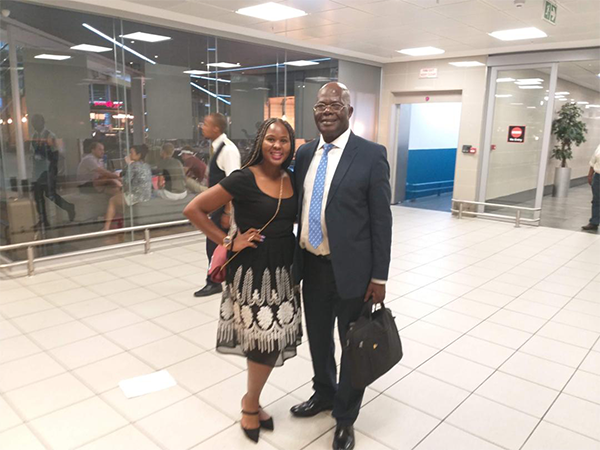
Mr Ramoshaba and his daughter, Makobe, before her departure to work in China in 2018.
ACADEMIC QUALIFICATIONS
MAJOR ACHIEVEMENTS
BUSINESS DEVELOPMENT & BOARD MEMBERSHIP
• Black Chain, Maponya and Tsele Shopping Centres in Soweto
• Kunene Brothers in the East Rand and Vivo Beer in Johannesburg
• Mogodi Memorial in Polokwane
• Motale Bus Service in Cape Town
• 87 people to Malawi in March 1989
• 142 people to Zimbabwe in September 1989
• 202 people to Cameroon in April 1990
• 65 people to the USA in October 1990
• 46 people accompanying President Mandela’s delegation to the UK after his inauguration
• The establishment of Mogudi Shopping Centre in Namakgale Township, Phalaborwa
• The construction of the tar road from the Phalaborwa-Gravellote road into Mashishimale Village by a Consortium comprising of one large established construction company (Du-Rite) and a number of locally based black businesses in the built-in environment arena.
• Ba-Phalaborwa Arts & Crafts Secondary Cooperative which is a super body of the primary cooperatives each of whom comprises of about 10 ladies from the different areas of Ba-Phalaborwa Municipality
• Ba-Phalaborwa Vaveki Kamoka – a 2 200 member strong investment vehicle comprising of a cross section of people, men and women, old and young, educated and illiterate, urban and rural, economically active and the unemployed, from throughout the 10 areas of Ba-Phalaborwa Municipality.
• The objective of this Ba-Phalaborwa wide investment and business development initiative is to act as a marketing and an investment vehicle through which members of the historically disadvantaged citizens of Ba-Phalaborwa can play an active role in the South African economic mainstream. It is worth noting that the leaders of the 5 traditional authorities of Ba-Phalaborwa, members of their families; and some councillors are members of their respective Vaveki entities in their personal capacities.
FUND MANAGEMENT & ADMINISTRATION
• During my tenure in some of the leading funding institutions in the country such as Lebowa Development Corporation (now called LDET) where I served as Chairman for 3 years, and as board member of DBSA and Business Partners, I was exposed to major fund management and administration transactions of all types and sizes.
• Outside of the above institutions and situations, I have had to deal with a number of fund management and administration matters of my clients and for other parties. I have given a number of lectures throughout the country and TV presentations on these topics on numerous occasions
SOCIO-ECONOMIC DEVELOPMENT & COMMUNITY UPLIFTMENT
• Large employment creation
• Spread of operations throughout a vast area
• Broad shareholding
• Economic impact of the project
• Skills development and transfer
• Support of the delivery of basic services
• Enhancement of shareholders’ interest
• Ability to complement black business efforts
• Investment promotion; and
• Uniqueness in terms of concept and implementation
SUPPORTING DEVELOPMENT THROUGH PRINT & ELECTRONIC MEDIA
• 1990 saw this need realised with the launch of the first annual publication in the Portfolio Publications stable, namely Portfolio of Black Business in Southern Africa. Former President Dr Rolihlahla Nelson Mandela wrote the Foreword to that first issue. Other leading personalities who contributed Forewords to the subsequent issues include, amongst others, Mr Edward VK Jaycox – Former Vice President of the World Bank: Africa Region (1994) and Mr Thabo Mbeki – then Deputy President of the Republic of South Africa (1996)
• Supportive of both the private and public sector initiatives and development in Africa, Portfolio over the years commissioned and introduced other publications in sectors such as local government, mining & energy; and one for South Africa as a whole.
• The Portfolio publications are packaged and produced in collaboration with the primary institutions in the chosen publication sectors. A typical example is SALGA for Portfolio of Municipalities in South Africa publication. The readership of the publications comprise of decision makers in both the public and private sectors in South Africa, throughout the African continent and internationally
• As a gesture of appreciation and support which the citizenry of Ba-Phalaborwa afforded me in my formative years, I dedicated two years of my time researching, documenting; and finally produced and published the first ever publication (355 pages) on the history and current developmental status of this illustrious community in the copper rich area at the mouth gate of the Kruger National Park in Limpopo Province.
• The publication is not only aimed at ensuring that the community’s history, traditions and values are recounted, captured and recorded for future generations, but it is equally intended to serve as a harmonizing tool amongst the local business community, the political leadership and the members of the community themselves. The publication is also being used as a guide and point of reference for future developments and for effective investment promotion and confidence building for the area of Ba-Phalaborwa
• In the 2000’s I produced weekly shows of 30 minutes each which were aired on one of the SABC TV platforms in the evening prime time. I acted as both the producer and presenter of the programmes. The TV series were aimed at affording leaders in both the public and private sectors an opportunity to pronounce and account on how they were factoring in the issue of black economic empowerment in the daily affairs of their respective institutions.
• Some of the notable people who featured included the outgoing Chair of the African Union Commission, Dr Nkosazana Dlamini Zuma in her then capacity as Minister of Health; and the current serving member of Parliament, Mr Amos Masondo in his then capacity as MEC of Health for Gauteng Province
• The series could not be sustained for long due to lack of sponsorship as the programmes were directed at calling on the same targeted sponsors (especially those from the private sector) to account on their black economic empowerment and community upliftment programmes which most of them were not ready to entertain at that stage
• In 2010 I entered into an arrangement with CNBC Africa where I produced and presented a series of 30 minutes Africa wide focussed programmes as a precursor to the then envisaged South Africa 2010 FIFA World Cup SABC supported TV and radio programmes which were to follow later
• Will the investment made in staging the FIFA 2010 World Cup South Africa make our leaders’ wishes and those of the ordinary citizens come true in creating a long-lasting legacy and the real sustainable benefits thereof?
• It was precisely these critical questions which the multi-media communication platform which I had created on the legacy of the 2010 event had aimed to answer. The platform was to provide the single largest, cheapest, most effective and far reaching medium in South Africa and the African continent through which every citizen would be informed and educated about the legacy of the 2010 event and the resultant benefits thereof
• My company had an agreement with the 2010 Local Organising Committee (LOC) to produce a minimum of 40 000 copies of a Souvenir Publication on the legacy of the 2010 FIFA World Cup South Africa event. The publication was to be complemented by a series of SABC backed television shows, radio programmes, mobile and the web
• Some of the public sector participating institutions at the time included SRSA, GCIS, DAC and CoGTA. The legacy projects were grouped into 26 themes ranging from the legacy of arts & culture, communication, transport to the legacy created at national, provincial and local levels
• After a period of well over two years of research, stakeholder consultations and the conclusion of several sponsorship and advertising arrangements; and shortly before the roll-out of the whole multi-media programme, there was a sudden change of heart from some of the key stakeholders and I thus had no option but to can the entire exercise.
• In view of the historical significance and the importance of safeguarding the activities and legacy of this once-in-a—life time event, I soldiered on to gather further material for the publication all of which I have since preserved for publication when the opportunity arises in the future